.png)


What drew you to Minerva University, and how has that experience shaped the way you approach your work and life today?
I mean, what do you mean I get to go to a good school and travel the world at the same time?! It sounded like the adventure of a lifetime. Little did I know it was just the start. It wasn't adventure, then done. It was teaching me how to live on my own terms and beginning to figure out what those were.
I work as a full-time artist, and occasionally organize hackathons in San Francisco. It's a weird niche career and I'm just rolling with the flow. The intersection of painting and tech might not be the space I occupy forever, but it’s the right starting point for now, and I like it here.
Most of my work is project-based independent, challenging and everchanging, like Minerva. It's a lot of finding and creating my own path, working with people, and making friends.
The fact that I find something in common with most people because of all the places and cultures I've met isn’t lost on me. In a cosmopolitan environment like San Francisco, it’s a huge benefit to be able to relate to people from all over. Heck, without Minerva, I wouldn't have my best friends, boyfriend, or weirdest, dreamiest job ever. I'm grateful.
Minerva is known for thinking across disciplines, how has that mindset shown up in your artistic voice or creative process?
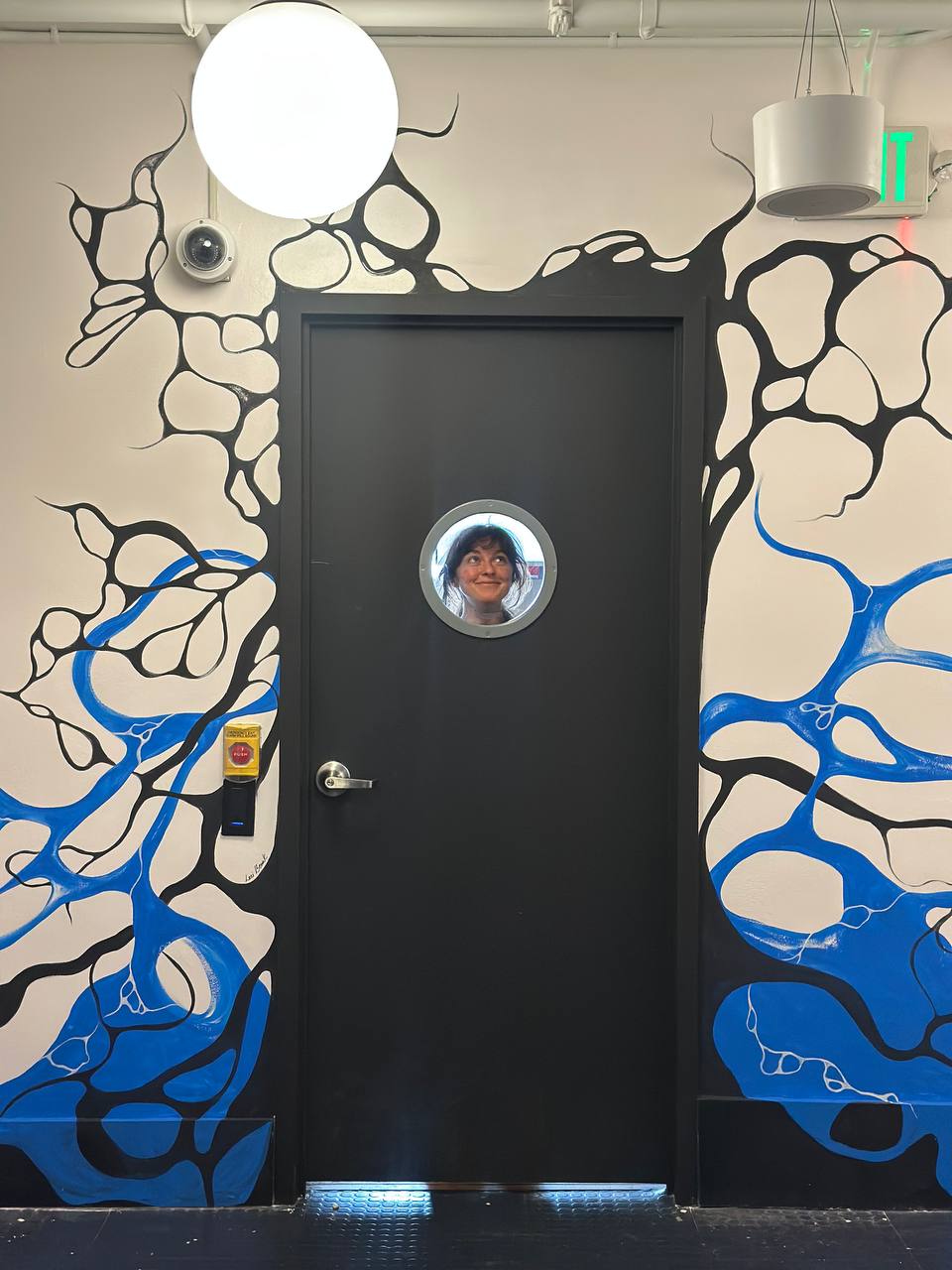
I joke that I work in tech - but I'm entirely non-technical. I don't even use Claude for emails. Yikes. I'm getting there. I'm a painter working in a tech company (Frontier Tower, AI Floor), teaching tech founders to paint and helping the community grow. I live at a discipline intersection. I still use my hands and a bottle of paint, I just sometimes get to paint on a robot. Other times I get to use the manpower of 30+ tech founders to repaint a hallway.
Random Minerva adventures paved the way, and each one has been useful in the most unexpected ways. I'm a big advocate of branchouts and side quests. I think any skill or experience will be useful to us at some point down the road, and the random things we learn or do will shape the bigger things later.
For example,I organized film festivals and a half marathon during Minerva. This year, I organized an art/music pop-up show, a tech conference (Funding The Commons: Intelligence at the Frontier), and a hackathon.
I'm surrounded by people who believe interesting ideas and solutions happen working across disciplines, and I agree. I think culture, tech, science, philosophy, politics and everything else works best when it works together. It's very cool that I get to be at some of these intersections and contribute my little piece.
Was there a defining moment when you decided to take the leap into a non-traditional path as a full-time artist?
I think it was right after I graduated. During Manifest, I was brutally aware how much I loved not only San Francisco, but the person I had become here. I was the strongest, happiest I'd been in a long time. I have found deep friendships and cool communities. So I decided to stay and see if I could make at least the OPT year work.
I came out of Minerva with an arts degree that didn’t teach me much about artmaking (except AH166 - Artistic Communication from Page to Practice, that class is forever in my heart), but I was, and had always been, an artist. I decided to be an artist because I didn't know how to be anything else.
I'm trying to change that now - to be an artist because, if, and when I want to, not because I need to be but because there is still something for me to explore. That requires me to also become something else. The challenge next year will be figuring out who that is.
A cool writer whose name I can't remember said writing is like driving through fog at night – you only see the headlights of the car ahead, and you follow them, not sure where the road leads. You take it bit by bit. I'm already seeing some outlines, very few, and I'm okay with following the road. I can't wait.
You’ve worked across murals, installations, and film, including Left on Turk. Is there a recent or favorite piece that really captures what you’re exploring right now?
“Believe in the me that believes in you” is a metal print that I started making on the floor of our 405 dorm room at 16 Turk. It was the work that got me my job, one of my best friends and coolest collaborators ever. I took it to an art fair, and it’s now hanging at Frontier Tower (9th floor) and also soon at an art show in Vienna (thanks mom!).
It's an abstraction of neural/organic patterns that transcends scales and meaningful forms to tap into something more fundamental - the organic network nature of life and thought itself. That's the spiel. It's named after my friend (and boss and collaborator), who is quite literally the reason I've been able to believe in myself this much. He is now making a projection-mapping program to go on top of this and other artwork. It's an ever-growing work that started with a print but has no end in sight. Shoutout Devinder!
At Frontier Tower, an interdisciplinary space where you’ve worked as an art & design associate and now contribute to leadership on the AI Floor, how has that environment shaped your work at the intersection of art and AI?
When I first got here, I felt like a bit of a double agent - an artist among tech brains who say things like ‘i don’t understand art’ and ‘i could make that’ or, even better, ‘my model can make that’. I've since then come to understand and appreciate the people here much more, and to see myself as part of this group as well. I'm constantly surprised at how valued I feel here, how much of a space there really is for me. I'm confirming once again that no matter who we are, we all like the basic things - camaraderie, community, nice spaces and nice people, creativity and play and decompression. It feels nice to be able to provide a bit of that sometimes.
Since starting your journey in August 2025, you’ve exhibited widely across San Francisco and brought an interactive piece to The Superfair at Fort Mason. What drew you toward collaborative art, and how is it changing the way you think about audience, value, and connection?
The collaborative piece at the art fair was pretty serendipitous. I spent the first few days of the art fair on a disillusioned emotional roller coaster. I'm just gonna quote my substack:
“does [this] mean the art world is not for me? that i’m not ready to sell to collectors? that i deeply dislike selling (which is kind of worse)? that i don’t belong here? where does that leave my career?” (substack)
Then, for a little fun fair activity, I did a collaborative painting demo. What was supposed to be a two-hour showcase became a two-day event. My booth went from least traffic to most traffic in the area I could see. I finally had fun. The people had fun. That shifted something for me.
I've been making collaborative paintings ever since, because I think art should be for everyone. And because making something together connects us, no matter who we are. It’s empowering and humbling at the same time. I finally feel like maybe I've got something that extends beyond me and my feelings here (not that there’s anything wrong with those - the personal is political, and everyone’s feelings are huge).
I just really like this other model of connecting through art. The challenge now is to figure out how to make things that are both community-driven and playful, and aesthetically thought-out and visually impressive. It's a fun challenge.

How has your relationship to “success” evolved since graduation, and what are you most excited to explore next?
I think I'm on a bit of a spiral. I started with, "I know what success means to me and it’s not money,” moved through “actually, I need money. It’s money” and eventually landed at “the money mindset is bad for me and I don’t even agree with it, I think I was just nervous and surrounded by it.” think success is progress. It's living in accordance with your values. It's being able to set goals/directions and commit to consistent effort without losing critical thinking or the ability to recalibrate. It's in the process more than some mythical material state. It sounds wishy-washy but that is how I want to think about it: I'm already there, because I'm on the way.
That's a good day. On the bad days I spiral back into stress, but that’s part of it too.
If you could leave the Minerva community with one honest piece of advice about building a life after graduation, what would it be?
Start before graduation. Minerva is a sandbox, it’s a training program, it’s a place you get to play and try things without getting too serious/pressured about it. The pressure comes when it needs to sustain you and when you need to present it to people as your “career.” Enjoy the fact that it might not be the case yet.
And if you’re graduating and feel underprepared as heck (that was me), no matter what, trust the process. And don’t forget your loved ones - people from before or during Minerva - they matter more than you know.
Lastly, some rules can be broken, and if you break the right ones, life might just get a lot more fulfilling. ✨
Quick Facts
Computational Sciences
Computational Sciences
Natural Sciences
Computational Sciences
Arts & Humanities, Natural Sciences
Social Sciences & Arts and Humanities
Business
Computational Sciences
Computational Sciences
Social Sciences & Business
Computational Sciences
Social Sciences
Computational Sciences & Business
Business & Computational Sciences
Computational Sciences
Computational Sciences
Social Sciences & Business
Business
Natural Sciences
Social Sciences
Social Sciences
Social Sciences & Business
Business & Computational Sciences
Business and Social Sciences
Social Sciences and Business
Computational Sciences & Social Sciences
Computer Science & Arts and Humanities
Business and Computational Sciences
Business and Social Sciences
Natural Sciences
Arts and Humanities
Business, Social Sciences
Business & Arts and Humanities
Computational Sciences
Natural Sciences, Computer Science
Computational Sciences
Arts & Humanities
Computational Sciences, Social Sciences
Computational Sciences
Computational Sciences
Natural Sciences, Social Sciences
Social Sciences, Natural Sciences
Data Science, Statistics
Computational Sciences
Business
Computational Sciences, Data Science
Social Sciences
Natural Sciences
Business, Natural Sciences
Business, Social Sciences
Computational Sciences
Arts & Humanities, Social Sciences
Social Sciences
Computational Sciences, Natural Sciences
Natural Sciences
Computational Sciences, Social Sciences
Business, Social Sciences
Computational Sciences
Natural Sciences, Social Sciences
Social Sciences
Arts & Humanities, Social Sciences
Arts & Humanities, Social Science
Social Sciences, Business
Arts & Humanities
Computational Sciences, Social Science
Natural Sciences, Computer Science
Computational Science, Statistic Natural Sciences
Business & Social Sciences
Sustainability
Sustainability
Natural Sciences & Sustainability
Natural Sciences
Sustainability
Computational Sciences
Computational Sciences
Computational Science & Business
Data Science and Statistics
Data Science and Statistics, Digital Practices
Earth and Environmental Systems
Cognition, Brain, and Behavior & Philosophy, Ethics, and the Law
Computational Theory and Analysis
Computer Science and Artificial Intelligence
Brand Management & Computer Science and Artificial Intelligence
Computer Science and Artificial Intelligence
Economics and Society & Strategic Finance
Enterprise Management
Economics and Society
Cells and Organisms & Brain, Cognition, and Behavior
Cognitive Science and Economics & Political Science
Applied Problem Solving & Computer Science and Artificial Intelligence
Computer Science and Artificial Intelligence & Cognition, Brain, and Behavior
Designing Societies & New Ventures
Strategic Finance & Data Science and Statistics
Brand Management and Designing Societies
Data Science & Economics
Machine Learning
Cells, Organisms, Data Science, Statistics
Arts & Literature and Historical Forces
Artificial Intelligence & Computer Science
Cells and Organisms, Mind and Emotion
Economics, Physics
Managing Operational Complexity and Strategic Finance
Global Development Studies and Brain, Cognition, and Behavior
Scalable Growth, Designing Societies
Business
Drug Discovery Research, Designing and Implementing Policies
Historical Forces, Cognition, Brain, and Behavior
Artificial Intelligence, Psychology
Designing Solutions, Data Science and Statistics
Data Science and Statistic, Theoretical Foundations of Natural Science
Strategic Finance, Politics, Government, and Society
Conversation
What drew you to Minerva University, and how has that experience shaped the way you approach your work and life today?
I mean, what do you mean I get to go to a good school and travel the world at the same time?! It sounded like the adventure of a lifetime. Little did I know it was just the start. It wasn't adventure, then done. It was teaching me how to live on my own terms and beginning to figure out what those were.
I work as a full-time artist, and occasionally organize hackathons in San Francisco. It's a weird niche career and I'm just rolling with the flow. The intersection of painting and tech might not be the space I occupy forever, but it’s the right starting point for now, and I like it here.
Most of my work is project-based independent, challenging and everchanging, like Minerva. It's a lot of finding and creating my own path, working with people, and making friends.
The fact that I find something in common with most people because of all the places and cultures I've met isn’t lost on me. In a cosmopolitan environment like San Francisco, it’s a huge benefit to be able to relate to people from all over. Heck, without Minerva, I wouldn't have my best friends, boyfriend, or weirdest, dreamiest job ever. I'm grateful.
Minerva is known for thinking across disciplines, how has that mindset shown up in your artistic voice or creative process?
I joke that I work in tech - but I'm entirely non-technical. I don't even use Claude for emails. Yikes. I'm getting there. I'm a painter working in a tech company (Frontier Tower, AI Floor), teaching tech founders to paint and helping the community grow. I live at a discipline intersection. I still use my hands and a bottle of paint, I just sometimes get to paint on a robot. Other times I get to use the manpower of 30+ tech founders to repaint a hallway.
Random Minerva adventures paved the way, and each one has been useful in the most unexpected ways. I'm a big advocate of branchouts and side quests. I think any skill or experience will be useful to us at some point down the road, and the random things we learn or do will shape the bigger things later.
For example,I organized film festivals and a half marathon during Minerva. This year, I organized an art/music pop-up show, a tech conference (Funding The Commons: Intelligence at the Frontier), and a hackathon.
I'm surrounded by people who believe interesting ideas and solutions happen working across disciplines, and I agree. I think culture, tech, science, philosophy, politics and everything else works best when it works together. It's very cool that I get to be at some of these intersections and contribute my little piece.
Was there a defining moment when you decided to take the leap into a non-traditional path as a full-time artist?
I think it was right after I graduated. During Manifest, I was brutally aware how much I loved not only San Francisco, but the person I had become here. I was the strongest, happiest I'd been in a long time. I have found deep friendships and cool communities. So I decided to stay and see if I could make at least the OPT year work.
I came out of Minerva with an arts degree that didn’t teach me much about artmaking (except AH166 - Artistic Communication from Page to Practice, that class is forever in my heart), but I was, and had always been, an artist. I decided to be an artist because I didn't know how to be anything else.
I'm trying to change that now - to be an artist because, if, and when I want to, not because I need to be but because there is still something for me to explore. That requires me to also become something else. The challenge next year will be figuring out who that is.
A cool writer whose name I can't remember said writing is like driving through fog at night – you only see the headlights of the car ahead, and you follow them, not sure where the road leads. You take it bit by bit. I'm already seeing some outlines, very few, and I'm okay with following the road. I can't wait.
You’ve worked across murals, installations, and film, including Left on Turk. Is there a recent or favorite piece that really captures what you’re exploring right now?
“Believe in the me that believes in you” is a metal print that I started making on the floor of our 405 dorm room at 16 Turk. It was the work that got me my job, one of my best friends and coolest collaborators ever. I took it to an art fair, and it’s now hanging at Frontier Tower (9th floor) and also soon at an art show in Vienna (thanks mom!).
It's an abstraction of neural/organic patterns that transcends scales and meaningful forms to tap into something more fundamental - the organic network nature of life and thought itself. That's the spiel. It's named after my friend (and boss and collaborator), who is quite literally the reason I've been able to believe in myself this much. He is now making a projection-mapping program to go on top of this and other artwork. It's an ever-growing work that started with a print but has no end in sight. Shoutout Devinder!
At Frontier Tower, an interdisciplinary space where you’ve worked as an art & design associate and now contribute to leadership on the AI Floor, how has that environment shaped your work at the intersection of art and AI?
When I first got here, I felt like a bit of a double agent - an artist among tech brains who say things like ‘i don’t understand art’ and ‘i could make that’ or, even better, ‘my model can make that’. I've since then come to understand and appreciate the people here much more, and to see myself as part of this group as well. I'm constantly surprised at how valued I feel here, how much of a space there really is for me. I'm confirming once again that no matter who we are, we all like the basic things - camaraderie, community, nice spaces and nice people, creativity and play and decompression. It feels nice to be able to provide a bit of that sometimes.
Since starting your journey in August 2025, you’ve exhibited widely across San Francisco and brought an interactive piece to The Superfair at Fort Mason. What drew you toward collaborative art, and how is it changing the way you think about audience, value, and connection?
The collaborative piece at the art fair was pretty serendipitous. I spent the first few days of the art fair on a disillusioned emotional roller coaster. I'm just gonna quote my substack:
“does [this] mean the art world is not for me? that i’m not ready to sell to collectors? that i deeply dislike selling (which is kind of worse)? that i don’t belong here? where does that leave my career?” (substack)
Then, for a little fun fair activity, I did a collaborative painting demo. What was supposed to be a two-hour showcase became a two-day event. My booth went from least traffic to most traffic in the area I could see. I finally had fun. The people had fun. That shifted something for me.
I've been making collaborative paintings ever since, because I think art should be for everyone. And because making something together connects us, no matter who we are. It’s empowering and humbling at the same time. I finally feel like maybe I've got something that extends beyond me and my feelings here (not that there’s anything wrong with those - the personal is political, and everyone’s feelings are huge).
I just really like this other model of connecting through art. The challenge now is to figure out how to make things that are both community-driven and playful, and aesthetically thought-out and visually impressive. It's a fun challenge.
How has your relationship to “success” evolved since graduation, and what are you most excited to explore next?
I think I'm on a bit of a spiral. I started with, "I know what success means to me and it’s not money,” moved through “actually, I need money. It’s money” and eventually landed at “the money mindset is bad for me and I don’t even agree with it, I think I was just nervous and surrounded by it.” think success is progress. It's living in accordance with your values. It's being able to set goals/directions and commit to consistent effort without losing critical thinking or the ability to recalibrate. It's in the process more than some mythical material state. It sounds wishy-washy but that is how I want to think about it: I'm already there, because I'm on the way.
That's a good day. On the bad days I spiral back into stress, but that’s part of it too.
If you could leave the Minerva community with one honest piece of advice about building a life after graduation, what would it be?
Start before graduation. Minerva is a sandbox, it’s a training program, it’s a place you get to play and try things without getting too serious/pressured about it. The pressure comes when it needs to sustain you and when you need to present it to people as your “career.” Enjoy the fact that it might not be the case yet.
And if you’re graduating and feel underprepared as heck (that was me), no matter what, trust the process. And don’t forget your loved ones - people from before or during Minerva - they matter more than you know.
Lastly, some rules can be broken, and if you break the right ones, life might just get a lot more fulfilling. ✨